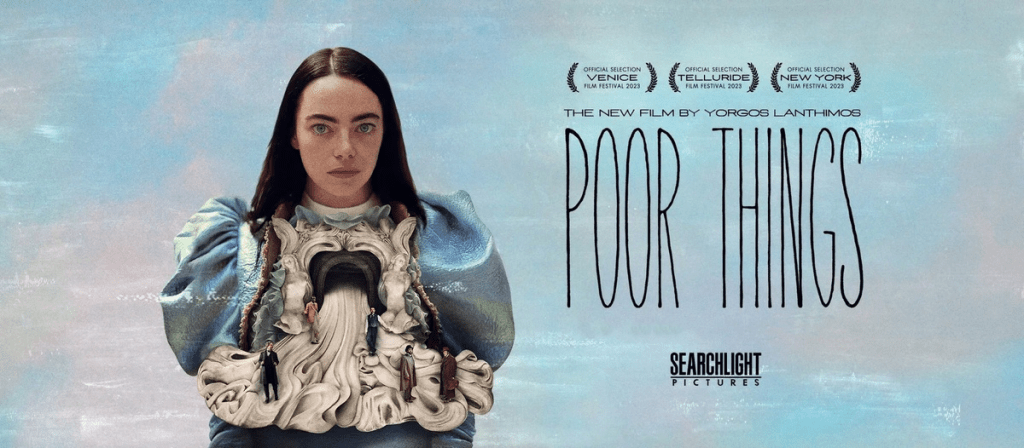
There is something that feels familiar about Poor Things. Behind its surreal, provocative imaging, I see a metaphor that I think neurodivergent women will recognise, whether they’ve named it yet or not.
The young, awakening Bella Baxter embodies more than just an odd, fantastical experiment. She reflects a pattern I know in my own DNA: the way the world romanticises, controls, and misunderstands women whose development doesn’t follow the linear script.
For me, especially because of the late diagnosis, development has never been linear. Emotional, cognitive, and social milestones don’t follow the expected order. Society, seems to be uncomfortable with this difference, tends to either infantilise or sexualise ND women, often both at once.
They call it “innocent,” “naive,” “too sensitive,” “quirky,” or “not like the others.” They praise discipline and responsibility while unconsciously exploiting the vulnerability. When underneath, we may be experiencing profound overwhelm, masking exhaustion, and unmet emotional needs.
While others our age seemed to “grow up,” I was busy surviving, hypervigilant, over-adapting, absorbing expectations I never fully understood. When the mask finally cracked, I started to awaken to my true DNA, and I faced another uncomfortable truth: most people only loved the mask!
In Poor Things, Bella’s awakening disrupts those who benefited from her earlier compliance. She was easy to shape when she didn’t know herself. When she begins to explore desire, agency, and intellectual independence, the discomfort of others rises.
I see this now in how society handles neurodivergent women stepping into self-authorship. When we start to question authority, defy or stop people-pleasing, or say no to roles we never chose, some cheer, but many recoil.
Often people will say:
“But you’ve always been so kind, so easy, so reliable.”
What they mean is: You served our comfort well.
But this discomfort isn’t really about our awakening, it’s about their loss of control.
It’s so easy to internalise the shame for awakening late. I grieve every day for the lost years, friendships, opportunities, and even identities. I know awakening later doesn’t mean I’m a failure, yet is still feels like survival, holding on with the tools I have.
Bella’s story shows that reclamation: a woman breaking free from others’ narratives to author her own. Neurodivergent women unmasking in adulthood seem to experience something similar. We rebuild our sense of self, this time from within, without external scripting.
There is an existential complexity to it. This awakening isn’t just psychological. It doesn’t seem that I can simply adopt a new coping strategy, but I question! Who am I without the mask? What was truly me? What was survival? Why did nobody see me sooner? Can I trust my own perception now?
That questioning is part of my neurodivergence, pattern recognition, deep processing, and existential sensitivity. It is the price of waking up, to me, as I very much enjoy this part.
Just like Bella refuses to accept marriage proposals or the roles men expect her to play, not out of rebellion for its own sake, but because her mind is naturally curious, unconditioned, and constantly evaluating whether these expectations make any actual sense to her. She doesn’t passively absorb society’s rules; she interrogates them.
Maybe some need to stop assuming that chronological age equals developmental sameness. For neurodivergent women, awakening may come at 20, 40, or 60. Emotional safety and self-understanding may take decades.
The movie Poor Things reminds me that becoming is never late. The neurodivergent path is not defective or strange, just unknown and nonlinear.
And like Bella, many of us are choosing now to no longer be shaped by others’ hands. We are not here to serve the comfort of those who misunderstood us. We are here to live fully, as ourselves, for the first time, awkward, wild, alive.
For my fellow late-diagnosed neurodivergent women: your awakening is not too late. It is your return.
©️Elke T.B. Stevens 14/06/25


Leave a Reply