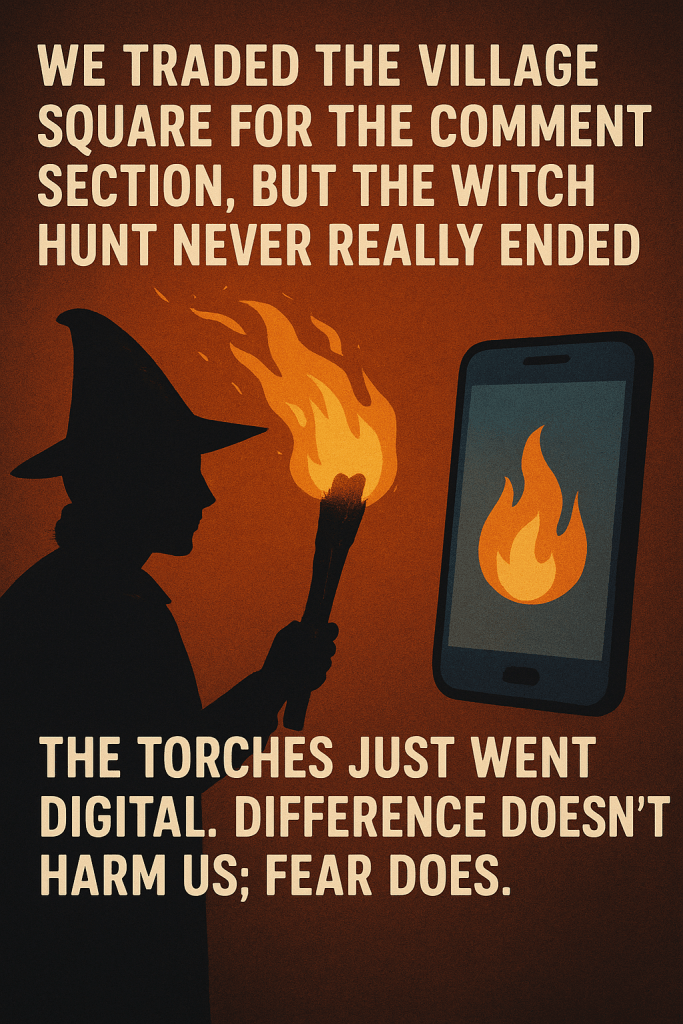
When I see social media come alive, I see torches and pitchforks all over again, the witch hunt reborn, glowing through the screens we hold so close to our faces. It makes me wonder if this is how far we’ve really evolved. The tools have changed, but the impulse remains the same: fear, outrage, and the collective need to cast someone out to restore a sense of order. Once it happened in the village square; now it happens in comment threads and timelines. The flames burn faster, and no one has to leave their home to join the crowd.
Perhaps the deeper question is “why” this pattern keeps returning. In the fables of old, people believed what a person in power declared, whether or not it was moral or true. That tendency hasn’t vanished; it’s only evolved. Today, influence has replaced authority, and visibility has become a new form of power. A confident tone, a viral post, or a crowd of supporters can transform an opinion into a moral law. Truth becomes a matter of social consensus rather than conscience.
Cancel culture has become today’s guillotine, fast, performative, and public. It claims to pursue justice but often acts out of fear: fear of being associated with the wrong person, fear of speaking too soon or too softly, fear of becoming the next target. In this climate, reflection feels dangerous, and forgiveness feels weak. What we call accountability can easily become a ritual of purification, where we destroy in order to feel righteous.
Some people frame this as a new feminism, but that conflation troubles me. True feminism was and is never about exclusion or domination. It was and is about voice, empathy, equity, rights, and law, breaking the cycles of silencing, not inheriting them. When any movement loses empathy and begins to mirror the tactics of those it once opposed, it ceases to evolve. It becomes another form of control.
So, I ask: what does this mean for free will? If we cannot be our own mind if fear of judgment dictates what we think, say, or even feel, are we truly free?
So if free won’t disappear outright, it gets quietly negotiated away. We still make choices, but within shrinking boundaries. The individual will become conditioned by the need for safety, social, emotional, and existential. We conform not because we agree, but because the cost of honesty feels too high.
This isn’t just a psychological issue; it’s sociological, biological, and historical all at once. The surrender of self to the collective is as old as our species’ history and the fables we tell. Biology wired us for belonging because, in early human history, isolation meant death. The body still responds to rejection or public humiliation as if it were physical danger.
Sociology builds on that instinct, constructing systems of reward and punishment that define what it means to be accepted.
Psychology resides in the middle, mediating between who we truly are and who we must appear to be to survive.
However, it doesn’t end there; even biology is shaped by sociology and its historical context. Our nervous systems, hormones, and stress responses are not frozen in time. Through epigenetics and neuroplasticity, we now know that the body remembers social experience. Generations of trauma, fear, and conformity can leave biological traces, the history of oppression and anxiety written into our very cells.
The body is not separate from society; it’s one of its most honest witnesses. Our biology changes in response to our surroundings, our upbringing, our culture, and even our collective past. Stress from social exclusion, constant comparison, or online hostility doesn’t just bruise the psyche; it reshapes the brain and the body. History, then, isn’t only preserved in books or monuments. It lives in flesh, in hormones, in reflexes. It’s inherited through how we react to fear, shame, or difference.
So, when modern witch hunts unfold on digital platforms, what we are witnessing is not a new phenomenon but an ancient one replaying itself, our evolved nervous systems still dancing to the rhythm of tribal fear. Social media amplifies what has always been there: our biological craving for safety within the group, our sociological conditioning to define outsiders, and our psychological need to believe we are on the “right” side.
And yet, there’s still a question of possibility: if biology, psychology, and society all feed each other, can we ever truly choose freely? I think the answer lies not in pretending to be untouched by these forces, but in becoming aware of them. Awareness is where autonomy begins. The moment we can see the pattern, we can decide whether to follow it or not.
How does it harm someone to be different? It doesn’t, not inherently. The harm comes from what society does with difference, how history teaches us to fear it, and how biology absorbs that fear as if it were truth. Until we unlearn that reflex, until belonging no longer depends on sameness, the witch hunts will return.
The torches and pitchforks may now be virtual, but the impulse remains the same: to destroy what unsettles us and to feel pure in the act. Our evolution, so far, seems more technological than moral. The question is whether we can evolve past the need for an enemy, whether we can stand to live without the fire.
© Elke T.B. Stevens 17/10/2025

 Notes from a Time Traveller by Elke Stevens
Leave a comment